

Most logistics managers still picture a van when they think “delivery vehicle.” It’s the default assumption. But in dense urban environments, that assumption is costing you time, money, and market position. The case for why e-bike fleets beat van delivery isn’t built on environmental idealism. It’s built on physics, economics, and operational data that increasingly points in one direction: for last-mile delivery in city cores, e-bikes outperform vans on nearly every measurable metric that matters.
Table of Contents
- Key takeaways
- Why e-bike fleets beat van delivery on speed
- The real cost comparison: e-bikes vs vans
- Environmental advantages that also affect your bottom line
- When e-bike fleets make sense and when vans still win
- My perspective on what this shift actually requires
- Ready to build your delivery e-bike fleet with Hmpbikes
- FAQ
Key takeaways
| Point | Details |
|---|---|
| Speed advantage is measurable | E-cargo bikes are 60% faster than vans in dense urban areas due to traffic and parking advantages. |
| Lower total cost of ownership | Cargo e-bikes can be up to 41% cheaper than electric vans over five years. |
| Dramatic energy reduction | E-bikes use 95% less energy per km than electric delivery vans on urban routes. |
| Context determines fit | E-bike fleets work best in high-density zones with strong bike infrastructure and short trip distances. |
| System design matters most | Micro-hub logistics paired with e-bike fleets delivers the highest efficiency gains, not simple vehicle swaps. |
Why e-bike fleets beat van delivery on speed
Speed is where the argument starts. Not top speed on an open road, but actual delivery speed measured stop to stop in real urban conditions. That distinction changes everything.
Van drivers average 147 seconds per stop just for parking and access. E-bike riders average 29 seconds. That’s a gap of over 118 seconds per delivery, and it compounds across every stop in an eight-hour shift. On a route with 50 stops, that’s nearly 100 minutes of pure waste for the van driver before they’ve delivered a single package.
E-bikes access bike lanes, cut through traffic, and park directly at the customer’s door. Vans circle blocks, double-park, pay fines, and deal with loading zone restrictions. The e-bike rider steps off, drops the package, and moves. The van driver is still looking for a legal space.
- E-bikes use dedicated bike infrastructure unavailable to motor vehicles
- Riders eliminate loading zone conflicts entirely
- No circling for parking means consistent, predictable stop times
- Access to pedestrianized zones where vans are banned outright
Pro Tip: Track your van drivers’ “friction tax” separately: the time lost to parking searches, fines, and circling. This hidden cost often consumes 30 to 40% of delivery time per stop and rarely shows up on standard route reports. Quantifying it makes the case for e-bikes impossible to dismiss.
The productivity math follows directly. If an e-bike rider can complete 25 to 30 stops per hour in a dense zone while a van completes 10 to 15, you’re not just saving time. You’re changing how many vehicles and drivers you need to service the same territory.
The real cost comparison: e-bikes vs vans
Operational speed is compelling, but the financial case is where most logistics managers make their final decision. The numbers favor e-bike fleets more decisively than most people expect.
| Cost category | Cargo e-bike | Electric delivery van |
|---|---|---|
| Vehicle purchase (CapEx) | $3,000–$8,000 | $35,000–$55,000 |
| Annual maintenance | $400–$800 | $2,500–$4,500 |
| Energy cost per 100 km | $0.08–$0.15 | $3.00–$5.00 |
| Insurance (annual) | $300–$600 | $2,000–$4,000 |
| Parking and fines (annual) | Near zero | $1,500–$3,500 |
| Cost per delivery drop | ~$1.92 | ~$5.00 |
Cargo e-bikes carry a 41% lower total cost of ownership over five years compared to compact electric vans, with annual savings of $7,800 to $12,000 per vehicle. At 35 or more deliveries per day, the break-even point arrives within 14 months. That’s a return on investment timeline that few capital equipment purchases can match.
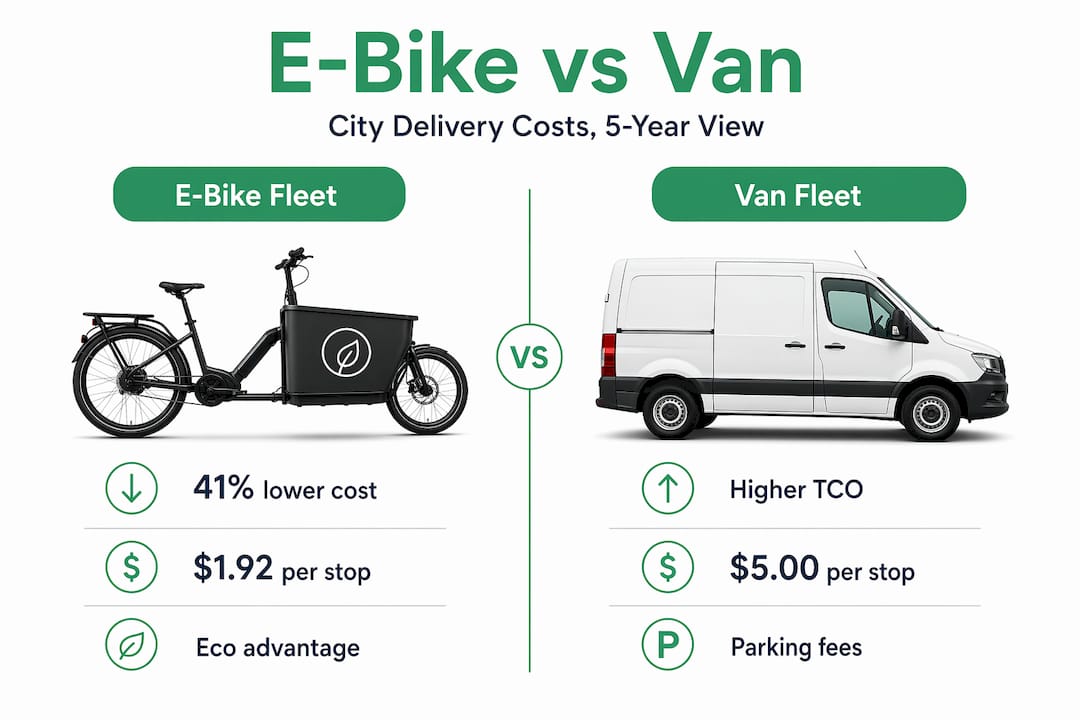
The cost per drop in city centers tells the sharper story. Vans average around $5.00 per stop when you factor in driver time, fuel or electricity, parking, fines, and vehicle depreciation. Professional cargo trikes come in at roughly $1.92. That gap adds up fast when you’re running hundreds of stops per day across a fleet.
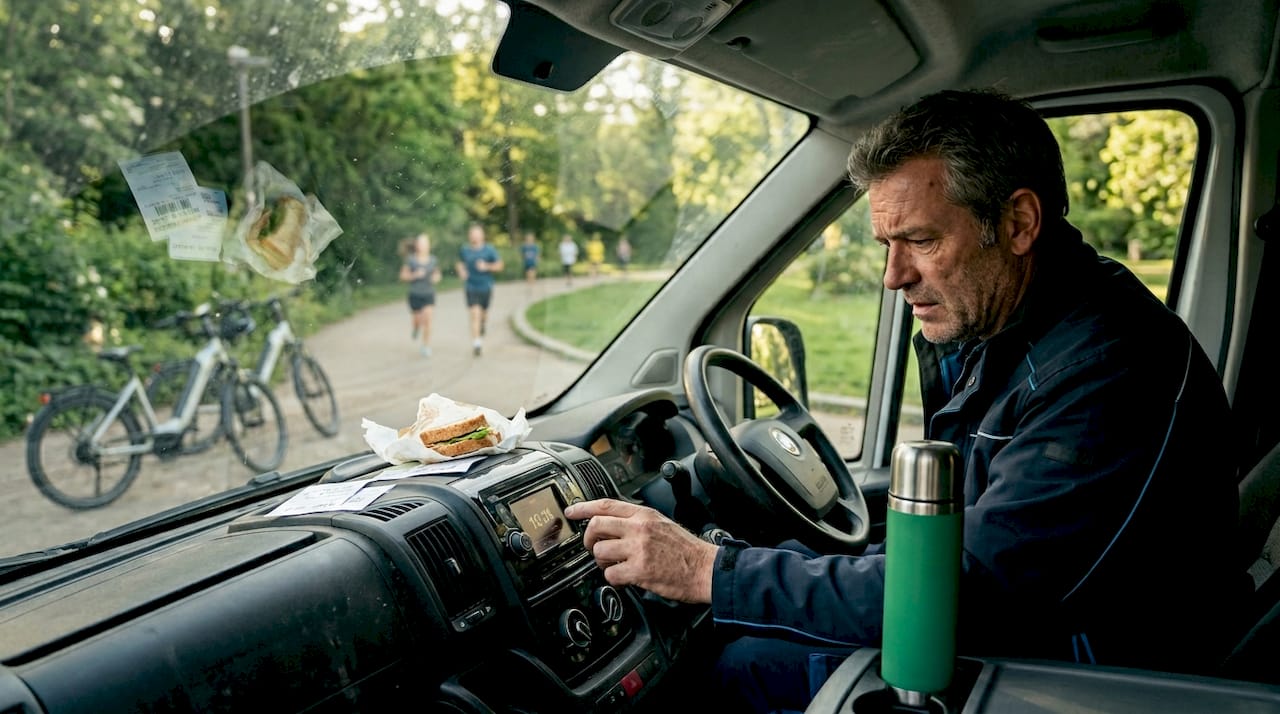
Van fleets also carry costs that rarely appear on a single line item. Congestion charges, expired parking meters, towing fees, and driver downtime while circling all bleed margin quietly. These aren’t edge cases. They’re predictable daily occurrences in any major city.
Pro Tip: Avoid consumer-grade e-bikes for commercial fleet operations. The economics only hold when the vehicle is built for industrial daily use. Professional cargo models with reinforced axles, high-torque motors, hydraulic braking, and certified batteries protect your ROI. A cheap bike that breaks down twice a week doesn’t save money.
Environmental advantages that also affect your bottom line
The environmental case for e-bike fleets is real, and it increasingly has financial and regulatory teeth attached to it.
Cargo e-bikes consume 8.3 Wh per kilometer on urban terrain with typical payloads. Electric delivery vans consume 182 Wh per kilometer. That’s a 95.4% reduction in energy intensity, measured on the same routes with comparable loads. Even accounting for grid emissions, the carbon footprint per delivery is dramatically lower for e-bikes.
From a regulatory standpoint, this matters now and will matter more going forward:
- Zero tailpipe emissions means full access to Ultra Low Emission Zones and future zero-emission delivery corridors
- Smaller vehicle footprint reduces road wear and reduces congestion externalities
- E-bikes use existing cycling infrastructure, which lowers the public cost of your operation compared to vehicles that require road space, loading zones, and parking structures
- Reduced noise pollution in residential areas translates to fewer complaints and better relationships with the communities you serve
Cities are adding delivery restrictions, not removing them. Urban last-mile delivery demand is projected to grow 78% by 2030. Van fleets that are already stressed by today’s restrictions will face compounding pressure. E-bike fleets align with where urban policy is headed, not where it started.
When e-bike fleets make sense and when vans still win
Honesty matters here. E-bike fleets are not a universal replacement for vans. The advantages are real and significant, but they’re conditional. Understanding those conditions is what separates smart fleet transitions from expensive mistakes.
E-bike fleets perform best when the following conditions are met:
- Delivery density is high. The ideal threshold is 4,200 residents per square kilometer or more, with at least 65% protected bike infrastructure coverage and trip distances under 8 kilometers.
- Payloads are package-sized. Cargo bikes handle standard parcel volumes well. Furniture, appliances, bulk freight, or palletized goods still require vans or larger vehicles.
- Micro-hub infrastructure is in place. Without nearby staging points, e-bikes lose their efficiency advantage fast. Without micro-hubs to reduce stem miles, e-bike fleets lose the productivity and cost advantages they hold over vans.
- Battery management is handled operationally. Cold weather reduces range significantly. A battery management system and strategic route planning protect against range failures, especially in climates that see harsh winters.
- Secure storage is available. Insurance premiums for e-bike fleets run about 20% higher than standard vehicles due to theft risk. Overnight storage needs to be secured, which requires planning and space.
The most effective approach most logistics operators are landing on isn’t an either-or choice. Vans handle bulk freight to urban micro-hubs, and e-bikes handle everything from those hubs to the customer’s door. This hub-and-spoke model captures the advantages of both vehicle types without forcing either one to operate outside its ideal conditions.
Suburban routes with low stop density, steep terrain, or heavy items remain van territory. The key is matching the vehicle to the route, not replacing one fleet with another wholesale.
My perspective on what this shift actually requires
I’ve watched a lot of logistics operators approach e-bike adoption the same way they’d approach buying a new van. Same process, same assumptions, just a different vehicle. That mindset misses the point almost entirely.
What I’ve seen work is treating e-bike fleet adoption as a system redesign. The 41% reduction in cognitive load that e-bike riders experience compared to van drivers isn’t just a comfort metric. It translates to fewer errors, better route adherence, and higher daily delivery capacity. Riders who aren’t stressed by traffic and parking perform better. That sounds obvious once you say it, but almost no one accounts for it in their operational models.
The quality issue is the other lesson I keep coming back to. I’ve seen operations undercut their own ROI by sourcing consumer bikes for commercial work. The economics only hold with purpose-built commercial hardware. Industrial-grade components aren’t a luxury specification. They’re the foundation of the cost model.
My honest take: the operators who resist this shift the longest tend to be the ones most attached to the operational systems they’ve built around vans. The micro-hub model requires rethinking your depot structure, your routing logic, and your staffing ratios. That’s real work. But the operators who do that work first are the ones who will be running leaner, faster, and more profitable city operations in three years while their competitors are still paying $5.00 per drop.
— Peter Chu
Ready to build your delivery e-bike fleet with Hmpbikes
If the cost and efficiency case has you ready to evaluate real hardware, Hmpbikes has delivery-specific electric bikes built for exactly the kind of daily commercial use this article describes. The INNO Class 2 delivery combo pairs a moped-style frame with a cargo rack and takeaway box system designed for professional stop-and-go urban routes. For operators evaluating multiple models and configurations, the full electric moped collection covers fleet-grade options across price points. Hmpbikes also supports fleet customers with maintenance, service, and parts access so your vehicles stay on the road instead of in the shop. Explore the lineup and find the right fit for your operation.
FAQ
How much faster are e-bikes than vans for urban delivery?
E-cargo bikes are consistently 60% faster than delivery vans in dense urban environments, primarily because van drivers lose over 100 seconds per stop to parking and access delays that e-bike riders avoid entirely.
What is the cost per delivery for e-bikes compared to vans?
The typical cost per delivery drop in city centers is approximately $1.92 for professional cargo trikes versus $5.00 for vans, reflecting lower energy, maintenance, and zero parking costs for e-bike operations.
Are e-bike fleets better for the environment than electric vans?
Yes. Cargo e-bikes consume 8.3 Wh per kilometer compared to 182 Wh per kilometer for electric delivery vans, making them 95% more energy-efficient per delivery even when both vehicles run on grid electricity.
When do vans still outperform e-bikes for delivery?
Vans remain the better choice for suburban routes with low delivery density, heavy or bulky freight, and areas lacking protected bike infrastructure. E-bikes excel in dense city cores with short trip distances under 8 kilometers.
What is a micro-hub model and why does it matter for e-bike fleets?
A micro-hub model positions vans to deliver bulk freight to small urban staging points, with e-bikes completing the final mile to customers. Without this structure, e-bikes lose their range and payload advantages and cannot compete with vans on efficiency.