

If you’ve ever bought an e-bike based on the “up to 80 miles” claim on the box, then watched your battery die at mile 35, you already know the problem. E-bike range explained properly is not a single number. It’s a calculation that depends on your battery, your body, your route, and how hard you’re pushing the motor. For San Francisco commuters and delivery riders navigating hills, stop-and-go traffic, and cargo loads, understanding what actually drives range is the difference between a reliable workday and a dead battery two miles from your next drop.
Table of Contents
- Understanding e-bike battery capacity and its role in range
- How real-world factors affect your e-bike’s range
- Calculating your personal e-bike range with safety buffers
- Comparing common e-bike battery sizes and expected range for urban commuters
- Practical tips to maximize your e-bike range in everyday commuting
- Rethinking e-bike range anxiety: what really matters for urban riders
- Explore HMP Bikes: electric mopeds designed for urban commuting and delivery
- Frequently asked questions
Key Takeaways
| Point | Details |
|---|---|
| Battery capacity matters | Watt-hours (Wh) is the key figure to compare e-bike batteries and estimate range accurately. |
| Real-world range varies | Rider weight, terrain, assist level, speed, and temperature significantly affect how far you can ride. |
| Calculate your own range | Measure your Wh per mile, divide battery Wh by it, then add a 20% buffer for safety. |
| Choose battery size wisely | Match your battery to your longest typical ride plus buffer, considering trade-offs in weight and cost. |
| Smart riding extends range | Use lower assist levels, maintain tires properly, and plan routes to maximize your battery’s lifespan and range. |
Understanding e-bike battery capacity and its role in range
Before anything else, you need to understand the unit that actually matters: watt-hours (Wh). This is the single most useful number when comparing batteries or estimating how far you’ll go. As battery energy capacity is measured in watt-hours, the formula is simple: Wh = Voltage (V) × Amp-hours (Ah).
Here’s why this matters in practice. Two batteries can look very different on paper but store nearly identical energy:
- A 36V × 15Ah battery = 540Wh
- A 48V × 12Ah battery = 576Wh
Those two batteries will perform almost identically in real-world range, even though their voltage and amp-hour specs differ. Without knowing Wh, you’d have no way to compare them fairly.
Common battery voltages you’ll see on electric bikes are 36V and 48V. Higher voltage generally means more power delivery and efficiency at speed, but total energy storage still comes down to Wh. A 48V system isn’t automatically “better” for range unless the Ah rating keeps the total Wh high.
Knowing your battery’s Wh is step one. Everything else, including consumption rate, terrain adjustments, and safety buffers, builds on this number.
Now that you understand the battery’s energy storage in watt-hours, let’s explore how this translates into actual riding range.
How real-world factors affect your e-bike’s range
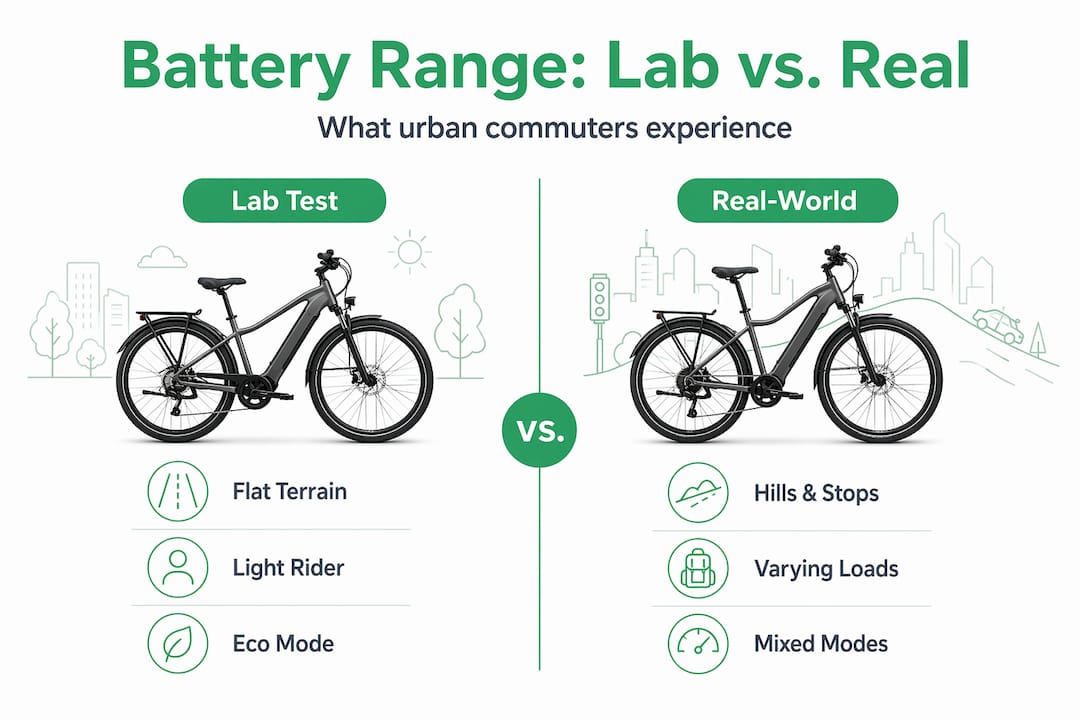
This is where manufacturer claims fall apart. Lab tests use flat terrain, light riders, mild temperatures, and low assist settings. Your commute across the Bay Area looks nothing like that.
Real-world energy consumption for mixed commuter riding typically lands around 18 to 22 Wh per mile. That means a 500Wh battery gives you roughly 22 to 27 miles of real-world range under typical conditions, not the 60-plus miles some manufacturers advertise.
Here are the main variables pulling your range up or down:
- Assist level: Turbo or high assist can consume 2 to 3 times more energy per mile than Eco mode. Switching from Turbo to Eco on a flat stretch can nearly double your range.
- Terrain: A single sustained climb burns dramatically more energy than a flat mile. San Francisco’s hills are not forgiving on batteries.
- Rider and cargo weight: Every pound adds load to the motor. Delivery riders carrying insulated bags, racks, and food orders feel this immediately.
- Speed: Air resistance increases exponentially with speed. Riding at 20 mph uses significantly more energy than 15 mph, even on the same flat road.
- Temperature: Cold weather reduces battery efficiency by 10 to 40 percent. Northern California winters are mild, but early morning rides in the 40s still affect performance.
- Tire type and pressure: Underinflated tires or wide knobby tires increase rolling resistance and drain your battery faster on pavement.
“The gap between claimed and real-world range is not a flaw in the bike. It’s a flaw in how range is communicated.” Understanding this gap is what separates confident riders from frustrated ones.
Pro Tip: On INNO-A 2023 electric bikes and similar commuter models, switching from Sport to Eco mode on flat stretches of your route and bumping up to Sport only on hills can extend your usable range by 30 percent or more without slowing you down meaningfully.
With these factors in mind, let’s examine how to calculate your personal e-bike range based on your specific riding habits and conditions.
Calculating your personal e-bike range with safety buffers
Generic averages only get you so far. Here’s how to build a number you can actually trust for your commute.
- Find your battery’s Wh capacity. Multiply the voltage by the amp-hours (V × Ah). This is on the battery label or in your manual.
- Estimate your Wh per mile. If your bike has a display showing energy consumption, track it over a few typical rides. If not, use 20 Wh/mi as a starting baseline for mixed urban riding.
- Divide battery Wh by your Wh/mi. A 500Wh battery at 20 Wh/mi gives you a theoretical maximum of 25 miles.
- Apply a 20% safety buffer. Multiply your result by 0.8. That 25-mile theoretical max becomes a reliable 20-mile real-world range. This accounts for hills, wind, and unexpected detours.
- Add a long-term degradation buffer. Lithium-ion batteries lose capacity over time. A battery that’s 2 years old may hold 80 to 85 percent of its original capacity. Factor this into your planning as the bike ages.
- Separate estimates by scenario. Calculate one range for your flat, easy days and another for heavy cargo or hilly routes. Having both numbers prevents surprises.
A practical calculation method is to estimate your Wh per mile, divide battery Wh by that figure, and add a buffer for variability and degradation. This gives you a range you can actually rely on rather than hope for.
| Battery size | Theoretical max (20 Wh/mi) | With 20% buffer | With degradation (85%) |
|---|---|---|---|
| 400Wh | 20 miles | 16 miles | 13.6 miles |
| 500Wh | 25 miles | 20 miles | 17 miles |
| 625Wh | 31 miles | 25 miles | 21 miles |
| 750Wh | 37 miles | 30 miles | 25.5 miles |
Pro Tip: Run your electric bikes range guide calculation twice: once for your daily route and once for your longest possible route in a week. The second number tells you whether you need a mid-day charge or a bigger battery.
Now that you know how to calculate your real-world range, let’s compare common battery sizes and their typical ranges to help you choose wisely.
Comparing common e-bike battery sizes and expected range for urban commuters
Manufacturer range claims are almost always optimistic, typically measured under ideal lab conditions. Real-world range runs 30 to 50 percent lower. Keep that in mind when reading any spec sheet.
Here’s how common battery sizes stack up for Northern California urban riders:
| Battery size | Realistic range (urban) | Best suited for | Trade-offs |
|---|---|---|---|
| 400Wh | 15 to 20 miles | Short commutes under 10 miles | Limited buffer; needs daily charging |
| 500Wh | 20 to 28 miles | Most urban commuters | Good balance of weight and range |
| 625Wh | 25 to 35 miles | Delivery riders, longer routes | Slightly heavier; better confidence |
| 750Wh | 30 to 45 miles | Heavy cargo, all-day delivery | Higher cost and weight |
A few things worth knowing before you choose:
- Most San Francisco commuters cover 8 to 15 miles round trip. A 500Wh battery handles this with room to spare.
- Delivery workers doing 6 to 8 hours of riding need either a 625Wh or larger battery, or a mid-day battery swap.
- Dual battery setups are available on some delivery e-bike options and can effectively double range, but they add weight and cost.
- Range anxiety drops significantly once you know your real number and have a 20 percent buffer built in. The anxiety is almost always about uncertainty, not actual distance.
With a solid grasp on battery sizes and ranges, let’s look at what you can do every day to squeeze more miles out of every charge.
Practical tips to maximize your e-bike range in everyday commuting
The biggest gains in range don’t come from buying a bigger battery. They come from riding smarter.
- Track your own consumption. If you’re doing daily delivery routes, tracking your Wh/mi is far more accurate than relying on averages. Factors like stop lights, cargo weight, tire pressure, and headwinds all affect your real number.
- Use the lowest assist level that works. Save Turbo for steep climbs. Use Eco or Tour on flat stretches. This single habit can add 5 to 10 miles of range on a typical day.
- Keep your tires properly inflated. Check pressure weekly. A tire that’s 10 PSI low increases rolling resistance noticeably. For urban pavement, a slick or semi-slick tire beats a knobby tread every time.
- Plan routes with elevation in mind. A route that adds two extra blocks but avoids a steep hill can save meaningful battery. Google Maps cycling mode shows elevation gain.
- Ride smoothly. Rapid acceleration from stops is one of the biggest energy drains in urban riding. Ease into your pedaling after a red light rather than hammering the throttle.
- Store your battery indoors overnight. Cold batteries start at reduced capacity. Bringing the battery inside and attaching it just before your ride keeps it at full efficiency.
Pro Tip: Review battery charging tips before you establish your daily charging routine. Consistently charging to 100 percent and leaving the battery depleted both accelerate long-term degradation. Charging to 80 to 90 percent for daily use and doing a full charge only when needed extends battery life significantly.
Rethinking e-bike range anxiety: what really matters for urban riders
Here’s the uncomfortable truth about range anxiety: it’s almost never about the battery. It’s about not knowing your actual number.
Range anxiety is usually a math problem, not a battery problem. The riders we see who are most confident on their bikes aren’t the ones with the biggest batteries. They’re the ones who’ve tracked their consumption, built in a buffer, and stopped trusting the “up to” number on the box.
Battery degradation is predictable. A well-maintained lithium-ion battery loses roughly 20 percent capacity over 500 to 800 charge cycles. That’s two to three years of daily commuting. If you charge properly and store the battery correctly, you’re looking at gradual, manageable decline, not a sudden cliff.
The riders who struggle most with range are the ones chasing bigger specs instead of building better habits. A 750Wh battery ridden carelessly on Turbo mode with underinflated tires will underperform a 500Wh battery used thoughtfully. Every time.
What we’ve seen at HMP Bikes is that the transition from range anxiety to range confidence happens the moment a rider stops guessing and starts measuring. It’s not a technology upgrade. It’s a mindset shift backed by a few simple numbers.
Technology keeps improving. Batteries are getting denser, motors more efficient. But rider behavior remains the biggest factor in real-world performance. Always has been.
Explore HMP Bikes: electric mopeds designed for urban commuting and delivery
Ready to put this knowledge into action? HMP Bikes offers a range of electric solutions built specifically for Northern California riders who need reliability, cargo capacity, and real-world range they can count on.

Browse the HMP electric mopeds collection to find models optimized for urban commuting with battery sizes that match your daily distance needs. If you’re in delivery, the delivery e-bike combo pairs a Class 2 electric bike with a cargo rack and takeaway box, built for last-mile logistics. Not sure which model fits your route? Test drive an eMoped and experience real-world range performance before you commit. Our team is here to help you find the right fit, not just the biggest spec sheet.
Frequently asked questions
What is the most accurate way to estimate my e-bike range?
Measure your actual watt-hours consumed per mile from typical rides, divide your battery’s total watt-hour capacity by that number, and apply a 20 percent safety buffer to account for variables and battery aging. This practical calculation method beats any manufacturer estimate.
How much does rider weight affect e-bike range?
Heavier riders increase energy consumption roughly proportionally, with every extra 10 pounds reducing range by about 5 to 8 percent as the motor works harder, especially on climbs. This weight-to-range relationship is especially noticeable for delivery riders carrying loaded cargo bags.
Does using throttle reduce my e-bike’s range?
Yes. Heavy throttle use can reduce range by 30 percent or more since it draws continuous high power from the battery, bypassing the efficiency gains of pedal assist modes.
How do cold temperatures impact e-bike battery range?
Cold weather reduces lithium-ion battery output significantly, with capacity dropping to 60 to 70 percent around freezing temperatures. Storing your battery indoors and attaching it just before riding helps retain warmth and preserve performance.
Is it better to have a larger battery or track my riding style for better range?
Tracking your personal energy consumption and using appropriate assist levels consistently delivers more reliable range than simply buying a bigger battery. As range anxiety research confirms, knowing your consumption and building in buffers solves most range problems without added cost or weight.