

Many California riders assume that if a bike has a motor and pedals, it qualifies as a legal electric bicycle. That assumption gets people fined, impounded, and turned away from bike trails every year. The definition of classification is not just an academic concept here. In California, it is the legal framework that determines what you can ride, where you can ride it, and what happens if your bike does not fit the right category. Understanding exactly how e-bikes are classified under state law is the difference between a smooth commute and a costly legal headache.
Table of Contents
- What classification means: from general definition to e-bike law
- California’s e-bike classification system: classes 1, 2, and 3 explained
- Why HMP Bikes’ LIVA 7 and INNO A PRO fit into Class 2 e-bike category
- Navigating legal riding: practical compliance and local restrictions in California
- Comparing California electric bike classes: summary table and key differences
- Why understanding California’s e-bike classification can save you from legal troubles
- Explore HMP Bikes’ compliant Class 2 electric bicycles today
- Frequently asked questions
Key Takeaways
| Point | Details |
|---|---|
| Classification organizes e-bikes by law | California law groups electric bicycles into Classes 1, 2, and 3 based on pedal operation, motor power, and speed limits. |
| Class 2 e-bikes have throttle assist | Class 2 e-bikes may use motor power alone up to 20 mph with throttles, differentiating them from Class 1 and 3. |
| HMP Bikes LIVA 7 and INNO A PRO are Class 2 | These models comply with California’s Class 2 criteria if properly configured with operable pedals and ≤750W motor. |
| Local rules affect where you ride | Even legal e-bikes may face local restrictions on bike trails and paths, so check local ordinances before riding. |
| Safety rules differ by class | Class 3 e-bike riders must be 16 or older and wear helmets; Classes 1 and 2 have fewer restrictions. |
What classification means: from general definition to e-bike law
Before we get into motor wattages and speed limits, it helps to understand what classification actually means as a concept. In general English, classification means the act or process of arranging things into groups or categories based on established criteria. That is the core idea: you take a set of objects, identify shared properties, and sort them accordingly.
The classification meaning here is not abstract. It is the same logic used in classification in biology, where species are grouped by shared traits, or in library systems, where books are sorted by subject. The classification process always involves three things: a defined set of criteria, a set of categories, and a method for assigning items to those categories.
California applies this exact logic to electric bicycles. The classification criteria are specific and technical:
- Does the bike have fully operable pedals?
- What is the motor’s maximum wattage?
- Does the motor operate only when the rider is pedaling, or can it run independently via throttle?
- At what speed does motor assistance cut off?
These four questions determine which class a bike belongs to, and that class determines everything from where you can legally ride to what safety gear you need. The importance of classification here is not theoretical. It is the legal backbone of California’s entire e-bike framework.
California’s e-bike classification system: classes 1, 2, and 3 explained
California Vehicle Code § 312.5 is the foundation. It defines an electric bicycle as a bicycle with fully operable pedals and an electric motor not exceeding 750 watts. If your bike does not have working pedals, or if the motor exceeds 750 watts, it does not qualify as an electric bicycle under California law. It becomes a moped or motorized vehicle, which carries entirely different registration and licensing requirements.
Within that definition, the law creates three distinct classes. Think of it as a classification system definition built on a ladder of speed and assist type:
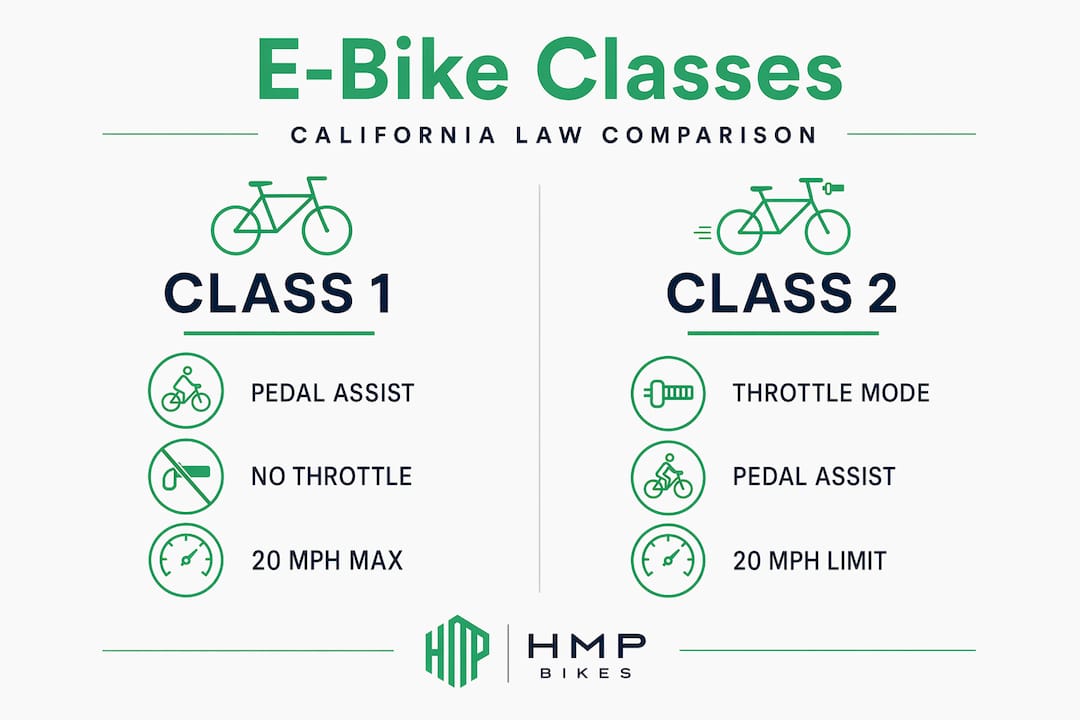
Class 1: A pedal-assist only electric bicycle. The motor helps you only while you are pedaling, and it stops assisting once you hit 20 mph. No throttle. No motor-only propulsion.
Class 2: A low-speed throttle-assisted electric bicycle. The motor can propel the bike without pedaling, but assistance stops at 20 mph. This is the key distinction from Class 1: the throttle.
Class 3: A pedal-assist only electric bicycle, like Class 1, but with a higher assist ceiling of 28 mph. A speedometer is required. No throttle allowed.
Here is a quick comparison to make the differences concrete:
| Feature | Class 1 | Class 2 | Class 3 |
|---|---|---|---|
| Motor max wattage | 750W | 750W | 750W |
| Throttle allowed | No | Yes | No |
| Pedal assist | Yes | Yes | Yes |
| Assist cutoff speed | 20 mph | 20 mph | 28 mph |
| Speedometer required | No | No | Yes |
| Typical use | Trails, paths | Urban commuting | Road commuting |
For riders in Northern California considering their options, our 2026 electric moped guide breaks down how these classes translate into real-world riding decisions. You can also browse our full electric bikes collection to see how these classifications apply to specific models.
Why HMP Bikes’ LIVA 7 and INNO A PRO fit into Class 2 e-bike category
Here is where classification theory meets real hardware. Two of the most popular models at HMP Bikes, the LIVA 7 and the INNO A PRO, are designed and configured to meet California’s Class 2 requirements. Let’s be specific about what that means.
A Class 2 e-bike must have fully operable pedals, a motor rated at or below 750 watts, and throttle or pedal-assist that cuts off at 20 mph. Both the LIVA 7 and the INNO A PRO meet these criteria when properly configured.
Key points riders should know about these models:
- Both have fully operable pedals, satisfying the foundational requirement of California’s electric bicycle definition
- Motors are rated at or below 750 watts, keeping them within the legal threshold
- Throttle and pedal-assist systems are configured to stop motor assistance at 20 mph
- Neither model is a motorcycle or moped when kept in stock configuration
- Neither qualifies as a Class 3 bike because they do not provide pedal assistance beyond 28 mph and are not designed for that speed range
One point that trips up a lot of buyers: the classification is about the bike’s configuration, not just its design intent. If someone modifies a Class 2 bike to bypass the 20 mph speed cutoff or installs a higher-wattage motor, it no longer qualifies as a Class 2 electric bicycle under California law. That modification can trigger registration requirements, insurance issues, and trail access problems.
Pro Tip: Before purchasing any e-bike, ask the seller to confirm the motor wattage and the exact speed at which motor assistance cuts off. Get it in writing. This documentation becomes your best defense if you are ever stopped and questioned about your bike’s classification.
Navigating legal riding: practical compliance and local restrictions in California
Knowing your e-bike’s class is step one. Knowing where you can legally ride it is step two, and this is where many riders get caught off guard.
California law restricts motorized bicycles on certain trails and paths unless local authorities explicitly permit their use. Even a fully compliant Class 1 e-bike can be banned from a specific trail if the local park district or municipality has passed an ordinance restricting it. Your bike’s legal classification does not automatically grant you access everywhere.
Here is a practical checklist for staying compliant on California roads and trails:
- Confirm your bike’s class with the manufacturer or seller before your first ride
- Check the specific trail or path rules for the area you plan to ride, not just general state law
- If you ride a Class 3 e-bike, verify you meet the age and helmet requirements before heading out
- Keep a copy of your bike’s specs, including motor wattage and assist cutoff speed, on your phone or in a bag
- When in doubt about a trail, look for posted signage or contact the managing agency directly
Class 3 riders must be 16 or older and wear helmets meeting ASTM or CPSC standards. This is not optional. It applies on public bike paths and roads, and enforcement is real in many California jurisdictions.
Local trail rules change more often than state law. A path that allowed Class 2 e-bikes last year may have new restrictions this year. Always verify current rules for your specific route, not just the general California e-bike framework.
For a deeper look at how these rules apply to specific vehicle types, our 2026 electric moped guide covers the distinctions between e-bikes, mopeds, and motorized bicycles under California law.
Pro Tip: The San Francisco Bay Area has some of the most varied local trail rules in the state. If you ride in multiple jurisdictions, keep a simple notes file on your phone with the rules for each regular route.
Comparing California electric bike classes: summary table and key differences
If you want a clean reference before making a purchase or planning a route, this table covers the essential distinctions. Vehicle Code § 312.5 defines all three classes by motor power, pedal assistance type, throttle use, and speed limits.
| Criteria | Class 1 | Class 2 | Class 3 |
|---|---|---|---|
| Motor wattage cap | 750W | 750W | 750W |
| Pedal assist | Yes | Yes | Yes |
| Throttle allowed | No | Yes | No |
| Motor-only propulsion | No | Yes (up to 20 mph) | No |
| Assist cutoff speed | 20 mph | 20 mph | 28 mph |
| Speedometer required | No | No | Yes |
| Minimum rider age | None specified | None specified | 16 years |
| Helmet required | No (under 18 yes) | No (under 18 yes) | Yes (all ages) |
The practical takeaway: Class 2 is the most flexible for urban riders because the throttle lets you move without pedaling, which matters in stop-and-go traffic. Class 3 is faster but comes with more restrictions. Class 1 is the most universally accepted on trails and shared paths.
Why understanding California’s e-bike classification can save you from legal troubles
Here is something most e-bike articles will not tell you: the classification system is only as useful as your ability to prove compliance in the field. Knowing that your bike is a Class 2 e-bike is not enough if you cannot demonstrate it to an enforcement officer.
Enforcement issues frequently arise from unclear documentation of assist and throttle behavior, along with motor power specifications that are not easily verifiable on the spot. An officer who cannot confirm your bike’s class may treat it as an unregistered motorized vehicle. That means potential fines, impoundment, and the hassle of proving compliance after the fact.
The confusion is often compounded by the physical appearance of certain e-bikes. Models that look like mopeds or scooters, even when they legally qualify as Class 2 e-bikes, attract more scrutiny. Riders of these bikes need to be more prepared with documentation, not less.
There is also a modification problem that the industry rarely addresses openly. Some riders modify their bikes to unlock higher speeds or bypass assist cutoffs. This is common enough that enforcement agencies are aware of it, which means compliant riders sometimes face extra scrutiny simply because their bike looks like it could be modified. Keeping your bike in stock configuration and having the manufacturer’s spec sheet available is the cleanest way to avoid that friction.
The broader point: the importance of classification goes beyond knowing which trail you can ride. It affects your legal standing, your insurance situation, and your relationship with local enforcement. Treat it as seriously as you would a driver’s license classification. Our electric moped guide covers the legal landscape in more detail if you want to go deeper.
Explore HMP Bikes’ compliant Class 2 electric bicycles today
If you have made it this far, you now know exactly what separates a legal California e-bike from a vehicle that requires registration, insurance, and a license. The next step is finding a bike that meets those standards without compromise.

HMP Bikes offers Class 2 compliant electric bicycles built to California’s 750-watt motor and 20 mph throttle limits. The LIVA 7 and INNO A PRO are designed for Northern California commuters, delivery riders, and everyday riders who want reliable, legal electric transportation. Browse the full HMP electric bikes collection to compare models, or schedule a test drive to experience Class 2 riding before you commit. Choosing a compliant bike from the start is the simplest way to ride with confidence.
Frequently asked questions
What is the maximum allowed motor power for an electric bicycle in California?
California law limits motor power to a maximum of 750 watts for a vehicle to qualify as an electric bicycle. Anything above that threshold is classified as a motorized vehicle and requires registration and a license.
Can a Class 2 e-bike use a throttle without pedaling?
Yes. A Class 2 e-bike may be propelled exclusively by the throttle motor up to 20 mph, but motor assistance must stop completely at that speed. This throttle capability is what distinguishes Class 2 from Class 1 and Class 3.
Are HMP Bikes’ LIVA 7 and INNO A PRO motorcycles or mopeds?
No. When configured with operable pedals, a motor at or below 750 watts, and throttle limited to 20 mph, both models qualify as Class 2 electric bicycles under California law, not motorcycles or mopeds.
Are there local restrictions on where e-bikes can be ridden in California?
Yes. Local authorities may prohibit e-bike use on specific trails or paths by ordinance, regardless of the bike’s legal class. Always check the rules for your specific route before riding.
What safety equipment is required for riding a Class 3 e-bike in California?
Class 3 riders must be at least 16 years old and wear helmets meeting ASTM or CPSC standards on public paths and roads. These requirements apply to all riders, regardless of experience level.